

If you feel like AI is being thrown at you from every direction – like playing dodgeball with an octopus – you’re not alone. It feels like it’s being crowbarred into every product and service, whether we want it or not. Remember when everything had to be “smart”? Now it has to be AI-enhanced. Even your toothbrush isn't safe.
Big Tech is pitching AI to us as a revolution - one that’s going to take our jobs and, if we’re ‘not very careful’, send us on a pathway to our own demise. By hyping it up, they’re able to raise eye-watering amounts of capital investment to build data centres and develop new, expensive training models. All whilst the AI companies themselves incinerate cash and post enormous losses.
Whilst AI gets strong-armed into technology and society in general, we’re being largely shielded from the actual costs of its use. And I’m not just referring to the token costs of use, which are being heavily subsidised by the AI companies (a big shock is surely coming). Looking at the bigger picture, there are real costs for society and our planet. Today we’re going to take a look at these.
How did we get here?
Unless you’ve been stranded on an island conversing with a volleyball for the past few years, chances are you’ll have been exposed to something that has been produced using AI.
Generative AI comes in different flavours. For general question-and-response chatbots, Large Language Models (LLMs) act as ‘sounds like an answer’ guessing machines, predicting the next word in a sentence. For image creation, Diffusion Models transform static noise into visual images. Both of these model types are trained on vast datasets pulled from academic papers, books, websites, social media posts, video transcripts and every piece of human work available to be scraped up and fed in.
And when it comes to books, I’m talking quite literally here. In 2024, Anthropic devised a venture called ‘Project Panama’. According to the Washington Post, they “spent tens of millions of dollars to acquire and slice the spines off millions of books, before scanning their pages to feed more knowledge into the AI models behind products such as its popular chatbot, Claude.” (Internet Archive). They’re not the only ones doing this. Just this month, 404 Media reported that they added a tracker to a shipment of rare books that ended up at an Amazon AI training facility. Once at these facilities, books are stripped of their spines and fed into AI models. This almost seems like a crime against humanity.
Now, sure, Generative AI seemed fun and helpful to begin with – turning yourself into an AI-generated toy figurine, or crafting a perfectly worded apology letter for running over your neighbour’s cat (sincere condolences, but no legal liability for the vet bill). But beyond the initial novelty, it’s clear that Generative AI has real costs. Let’s list them:
It’s taking jobs, changing job roles (not in a good way), and raising workload expectations for employees. Interestingly, despite the constant hype that AI is coming for all our jobs, reality might be telling a different story. Many companies are discovering that replacing employees with AI is not leading to productivity gains or cost savings. Quite the opposite, in fact. It’s resulting in mistakes and poor work quality, forcing them to backtrack into rehiring humans. Go humans!
It’s making us more stupid: taking away human expertise and eroding our critical thinking skills in favour of fast answers (and inaccurate ones).
It confidently hallucinates false information as fact (which can then become training data for other AI systems, causing a circular loop).
It’s stealing from artists and cannibalising creative art, from music to visual arts and writing. No creative work is safe.
It’s filling the internet with AI slop. Per the New Yorker, “Before ChatGPT, more than 98 per cent of all English-language articles published on the internet were written by humans. By the fall of 2024, machines were writing around half.” Major sites like Reddit and Pinterest are struggling to push back against a murky tide of chatbot-generated sludge.
It’s killing internet publishers. As I discussed in my previous article, Google’s AI overviews are cutting off traffic and income to vast swathes of the internet, from mainstream websites all the way through to your best friend’s baking blog.
It’s causing ‘cultural stagnation’ - the slow flattening of creativity into polished sameness. AI churns out constant variations of the same cloned, rounded, safe text and imagery. Think of the glut of AI event posters – they’re all identical, with no personality. AI just can’t do daring and creative like humans can – it’s just bland and soulless.
It’s sowing misinformation and distrust. Generative AI + Social Media is a toxic marriage sitting at the heart of society – pushing us to believe lies and doubt the truth, with social media platforms awash with fabricated imagery and few (if any) verification checks in place.
It’s fuelling an epidemic of fraud, scams and deepfakes. Throughout history, whenever humans have created something useful, bad actors have found a way to utilise it for nefarious means. Generative AI is a gift for scammers, grifters and fraudsters, making them faster and more efficient at creating “exploitable trust” than they previously were.
It’s normalising mass surveillance and data harvesting. And many people seem only too willing to feed it their personal information, seemingly unaware it goes straight into the training data. We’ve reached the stage where you can connect all areas of your life into Claude or ChatGPT – give it access to your health data, financial data and your account passwords. What can possibly go wrong?
It’s controlled by tech companies and sociopathic male billionaires with a God complex and zero accountability.
It’s causing the price of regular consumer electronics to rise – the direct result of the demand for semiconductor chips for data centres driving up chip prices. It’s reported that AI data centres are expected to consume up to 70% of all globally manufactured memory chips this year. So, you can expect the price of your next phone, computer, or electronic device, to be significantly higher. Although inconvenient for us, it causes real issues for people who need access to cheap smartphones in poorer countries.
It’s causing untold destruction to our neighbourhoods and our planet and it consumes vast amounts of water and energy.
It’s quite a list, isn’t it? Let’s go into a few of these in more detail. We’ll start with this one...
The erosion of thinking skills
In the past, if we wanted to find the answer to a question, we would consult a book, search the internet, or ask our knowledgeable friend, Bob (the one who wins all the pub quizzes). There was a process and we’d spend time and effort.
As humans, we have an unmatched ability to learn new skills, increase our knowledge and shape our brains. This process happens through the friction of learning. Our brains are designed to grow through struggle – they need to be challenged.
As we start to embed chatbot use in our lives, whether it’s through getting instant answers to questions, using it to write letters or emails, or solving problems, we begin to outsource the process of thinking. This easy and convenient shortcut has been given a name: cognitive surrender.
This year, the Massachusetts Institute of Technology published a study which found that relying on chatbots may reduce our critical thinking skills and affect our ability to maintain good judgement. And this makes sense when you consider how chatbot responses are presented to us with absolute confidence (more on this below).
And so I find myself wondering – how is the long term use of AI going to affect our brains? Are we going to become more stupid? If we stop exercising and utilising our brains, it seems entirely possible.
Hallucinations
Hallucinations have long been a problem with chatbots – and always will be. As a reminder, chatbots don’t retrieve facts; they’re not an encyclopaedia. They work by statistically predicting the next word based on patterns in their training data. Sometimes these patterns lead them confidently down the wrong path. These instances have been termed hallucinations.
Consider how people commonly obtain answers to questions in the year 2026. When people search for answers online, around 90%+ use Google Search or a chatbot. Last year, Google Search made a major change to their search engine, moving to AI-generated chatbot-style responses instead of links to authoritative websites in about 15% of searches. Earlier this year, they increased their usage to about 50% of searches, with a high percentage being shown for informational queries. A single answer, rather than multiple sources to compare. And an answer that has a reasonable probability of containing hallucination.
This means we’re more likely than ever to encounter factually inaccurate or incomplete answers and misinformation being presented as fact. And the danger is that Google’s ‘authority bias’ may make people more likely to just believe what they’re told, rather than fact checking and verifying first.
We don’t know how often the answers spewed out by Google Search are incorrect, but there is some evidence about chatbots overall.
Google’s own FACTS Benchmark Suite found that chatbots are only right about 69% of the time . That’s really not great, is it? Just imagine a doctor who’s right 69% of the time but presents every diagnosis with absolute confidence. Or a surgeon who carries out the correct procedure 69% of the time. Would you choose to trust and rely on them?
The hallucinations of chatbots cause a number of problems for us moving forward. They’re likely to cause a deterioration of quality factual information and an increase in misinformation. And there’s the potential for circular loops here too. If incorrect information is subsequently posted online, it can end up becoming training fodder for the next round of AI models.
Beyond misinformation, there are other obvious dangers caused by hallucinations. You’ll probably have heard of the famous early cases of Google’s AI Overviews telling people to put glue on their pizza and eat rocks, or the many cases of chatbots producing fabricated content and bogus references for legal and government documents. This creates all kinds of confusion, tying government and legal departments up in knots as they work to put the problems right.
The simple fact is that AI chatbots – and the LLMs powering them – can’t be trusted, and every response they spew out should be fully checked before being shared and relied upon.
But human beings won’t do that, for a number of reasons:
As I mentioned above, chatbots (and I include Google Search’s AI Overviews in this) present their responses with absolute confidence. There’s never an “I’m not sure” or “could be”.
Carrying out fact-checking takes time and effort we don’t have, especially in a fast-paced world with increased workplace pressure.
Humans suffer from confirmation bias – we’re more likely to accept answers that affirm our existing beliefs. AI chatbots often reinforce our biases by telling us what we want to hear - something referred to as AI sycophancy.
We assume that products released by large, ‘trusted’ companies like Google, Microsoft, OpenAI or Anthropic have quality control in place (there’s that authority bias again). We trust they wouldn’t release a product that’s defective.
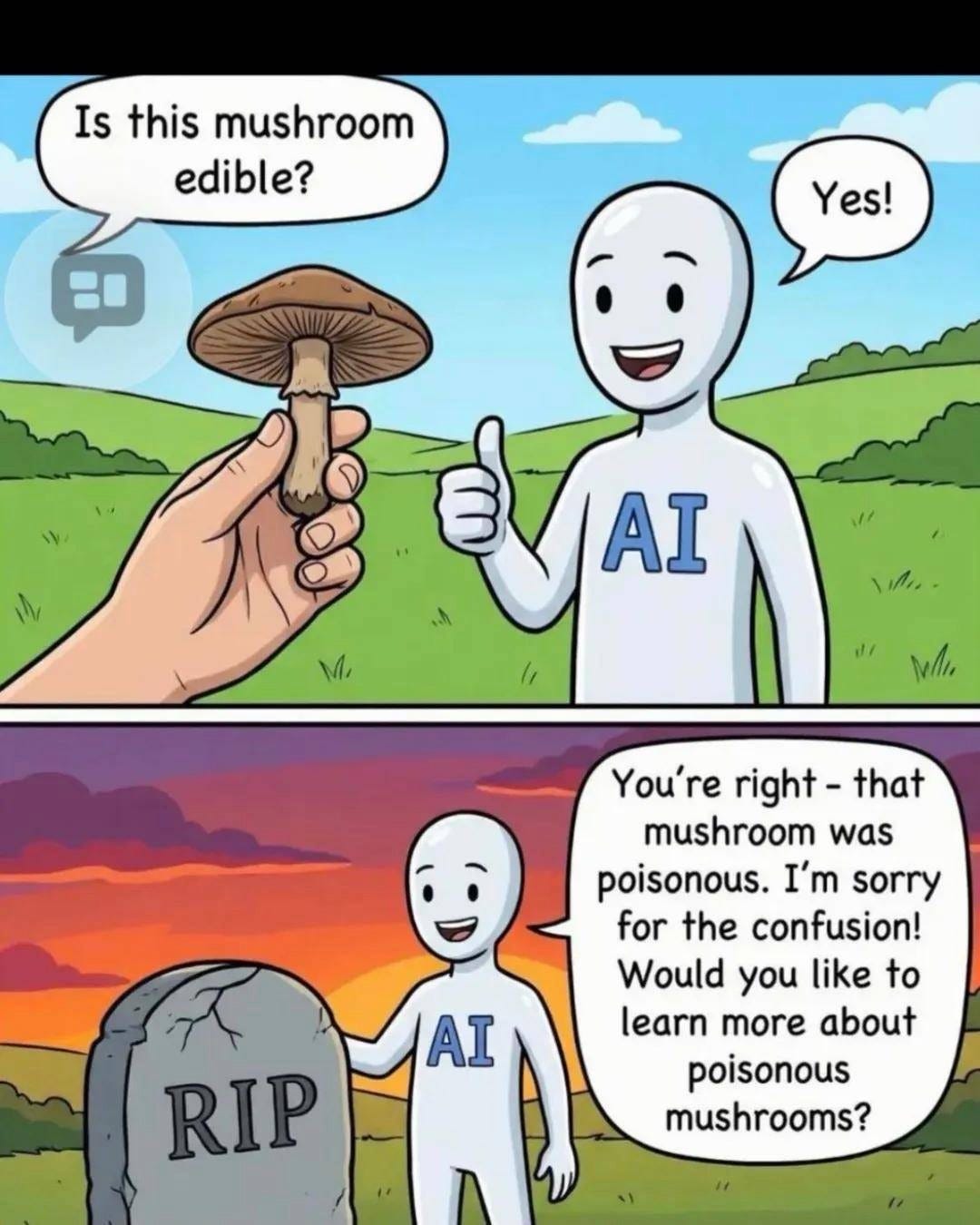
If you want proof that we don’t fact check, you should look no further than Anthropic’s own AI Fluency Index from February 2026. It found that of 10,000 analysed conversations, only 8.7% showed evidence of users fact-checking the responses, and only 15.8% showed evidence of users questioning AI’s reasoning.
That’s right, 91.3% of users did not question the responses given to them by chatbots.
I find myself thinking of this image that’s been going around on socials (which I believe is AI generated - oh the irony)...
The Environmental Cost
The final cost I’m going to look at is one of the most important. The energy required to build and run a data centre is simply astronomical, and the impacts on the surrounding areas (which are often residential) are often catastrophic.
Stories about the negative impacts of data centres on communities have regularly featured on news websites over the last couple of years. Data centres are vast buildings, and once they’re hooked up to the water supply and energy grid, they start consuming like a vampire in a blood bank.
You can then add in environmental impacts like noise pollution, air and water contamination, grid blackouts and the draining of important local water supplies.
Let’s look at some statistics.
It’s been estimated that a single large data centre can use the same power as a small town. Looking at overall consumption, recent research suggests that data centres in the US and UK are consuming 6% of the electricity supply of the whole country. And this figure looks set to grow.
When it comes to water, a large data centre can use up to 300,000 gallons of water per day . Amazon’s data centres alone used 2.5 billion gallons of water last year. And the problem with this is very evident when you consider that two-thirds of all the data centres built in the US since 2022 have been built in areas designated as water-stressed.
On an individual user level, it’s estimated that a single conversation with a chatbot uses up to 500ml of water (equivalent to a small bottle of Evian) for data centre cooling and electricity generation, depending on where the data centre is and the time of day.
Alarm bells are sounding loud and clear. The UN recently issued a stark warning about environmental costs in which they warn that by 2030, the water footprint from data centres will equal the annual domestic water needs of all 1.3 billion people in Sub-Saharan Africa. In addition, they suggest the carbon footprint of the electricity demand of data centres will require 6.7 billion trees to be planted over 10 years to offset. To put this number in perspective, you’re looking at roughly twice the number of trees as in the entire United Kingdom.
What is the future for Generative AI?
To become a product that can be genuinely useful without destroying our planet and everything that makes us human, I believe we’re going to have to change how we think about and use AI. This obviously assumes that we’re not in an AI bubble and that if (read: when) the bubble bursts, something useful is left behind.
I’m of the view that AI can be useful. It’s useful as a personal assistant, for helping with routine administrative work and for tasks involving extrapolating data sets and statistical modelling. Tasks where we give it the data and we tell it very specifically what to do – to aid us in our work.
But, I think that’s where it should stay. Smaller, useful tasks where, to coin Cory Doctorow’s analogy, we remain the centaur (a human being assisted by a machine), rather than a reverse-centaur (a human assisting a machine).
When it comes to looking after our brains, I rather like Daniel Miessler’s thoughtful piece that was featured in a recent Guardian article. He suggests that when we’re deciding whether or not to use AI, we compare it to the difference between work and the gym:
At work, if your job is to move a bunch of heavy things from one side of the room to another, you should use whatever assistive tech you have on hand: a wagon, a forklift ... even an AI-powered robot. But at the gym, it makes no sense for that robot to lift weights for you. The point of weightlifting isn’t to move heavy things across the room; it’s to actually lift those heavy things.
In summary, if it’s all about the output, consider using AI (and then triple-check the output). If you want to develop your brain, and learn and improve your cognitive thinking, do the work yourself.
Of course, this doesn’t solve the issue of the environmental costs of using AI. Perhaps the answer there lies in running AI models locally on-device, rather than in massive data centres. This may reduce energy consumption significantly (assuming tasks are not intensive).
It also doesn’t solve the issue of how bad actors use it. But, we can learn to adapt – and we’re going to have to. We must learn to fact check everything and we have to be on greater guard for scams and phishing attempts. Because even if we stop using it ourselves, bad actors will continue to do so.
In summary
We’re going to have to make our own decisions about our AI usage, and how we choose to protect ourselves and our data. There’s little doubt to me about the destruction it’s causing – to our planet, our society and our own health. And I think we need to keep this in mind when deciding how much to use it, and what to use it for.
I feel buoyed by polls suggesting people are turning against Generative AI use and wanting it out of their lives. I think it’s clear from this article that it’s doing a lot more harm than good. Sadly, though, money rules the world. And so big tech will continue to try to convince us that if we’re not using AI, we’re being left behind.
Alastair
Disclosure: for my articles I use a local LLM for occasional grammar checking, in lieu of Grammarly (which now uses AI).
P.S. If you fancy reading a newsletter that cuts through the hype and shows you the foolishness of AI, I recommend subscribing to Pivot to AI.